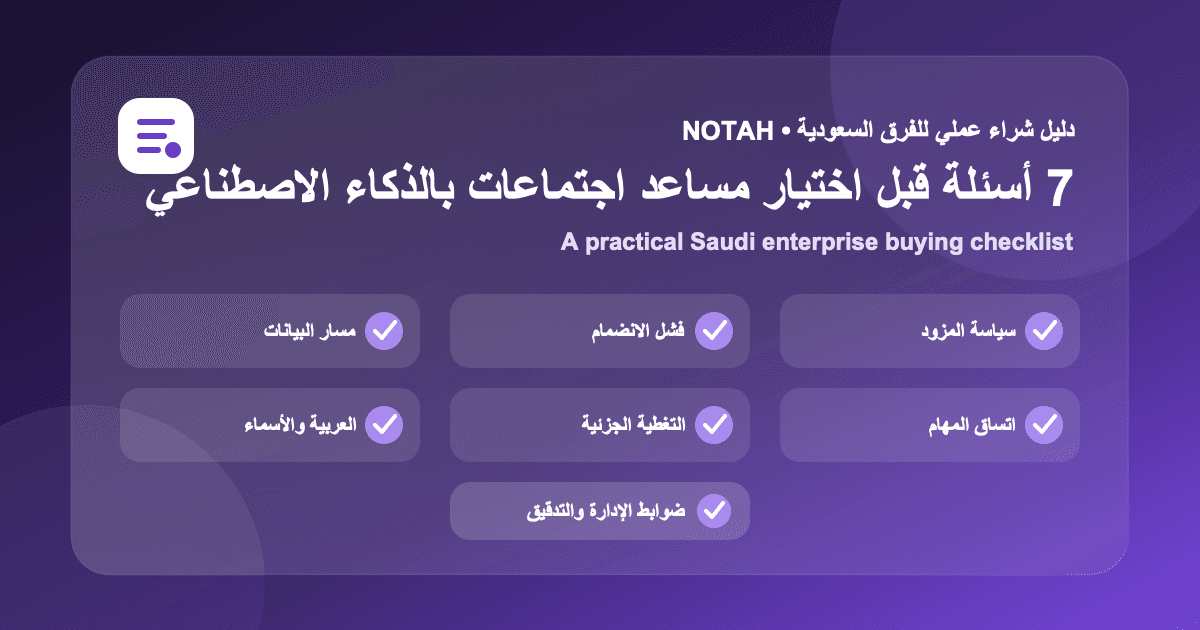
7 Questions Saudi Teams Should Ask Before Choosing an AI Meeting Assistant
A practical buying checklist for Saudi teams evaluating AI meeting assistants: data processing, bot fallback, provider control, Arabic context, partial transcripts, action items, and administration.
Quick Answer
Saudi teams should evaluate the full data path, bot-join fallback, provider controls, Arabic and English context, partial-transcript handling, action-item consistency, and administrator visibility before choosing an AI meeting assistant.
Why this checklist matters
An AI meeting assistant does more than produce text. It can receive meeting invitations, join calls, move audio between services, create transcripts and summaries, identify follow-ups, and expose the result to a wider workspace.
For a Saudi team, the buying decision therefore covers operations, language quality, security, deployment policy, and accountability. A polished demo is not enough. Ask for evidence against the workflow your team will actually use.
1. Where does every part of the data path run?
Map the complete flow, not only the transcription model:
- meeting platform and bot or browser capture
- temporary recording and upload
- speech-to-text processing
- speaker labeling or diarization
- summary and action-item generation
- object storage, database, logs, backups, and support access
Ask for a data-flow diagram and a list of subprocessors. Confirm retention, deletion, backup locations, encryption boundaries, and support access contractually. Data residency is not the same as full air-gap capability.
2. What happens when the meeting bot cannot join?
Join failures are normal operational cases: waiting-room policy, a changed login flow, platform restrictions, account exhaustion, or an organizer denying entry.
A credible product should answer:
- What status does the user see?
- How quickly is failure detected?
- Is another approved account attempted?
- Is a browser or microphone fallback available and allowed by policy?
- Does the system preserve useful diagnostics without exposing sensitive data?
- Can it ever report success without a usable recording?
3. Can an administrator choose the provider and the allowed fallback?
Provider choice is a policy decision, not only a model setting. A useful control should distinguish:
- primary provider;
- explicitly allowed fallback providers;
- language and diarization requirements;
- region and retention constraints;
- cloud-allowed versus no-cloud operation;
- credential ownership and rotation;
- behavior when no compliant provider is available.
4. How are Arabic, English, proper names, and speakers evaluated?
Arabic quality cannot be reduced to one headline percentage. Use a representative test set that includes:
If the preferred transcription model has no native speaker diarization, ask whether a separate, approved diarization stage exists and how its output is aligned with transcript timestamps. Test the combined pipeline, not the ASR model in isolation.
5. How does the system represent partial or uncertain transcription?
“Some text was returned” is not the same as complete success. Ask the vendor to expose:
- audio duration expected and processed;
- failed chunks and time gaps;
- finish reason and truncation status;
- confidence or uncertainty where available;
- whether overlapping chunks are deduplicated without deleting genuine repeated speech;
- whether a summary is blocked when source coverage is incomplete.
6. Do summary action items and workspace tasks come from one source?
Ask the vendor to trace one action item from the transcript to the displayed summary and into the workspace task list. The important questions are:
- Is there one canonical action-item artifact?
- Is each task linked to its meeting and source evidence?
- What happens when task creation fails after the summary is saved?
- Can the system retry without creating duplicates?
- Can a user see that synchronization is incomplete?
Two independent AI passes can create plausible but different tasks. Consistency and recovery matter more than producing a larger list.
7. What can an administrator audit and control?
A useful admin surface should show effective behavior, not only stored settings. Review:
- organization and plan entitlements;
- source value versus effective value;
- dependencies, conflicts, and restart requirements;
- provider policy and credential scope;
- failed joins, incomplete recordings, partial transcripts, and retries;
- access, sharing, retention, and deletion controls;
- changes with actor, time, and previous value.
A practical pilot scorecard
How to evaluate Notah
Notah is designed to turn recorded meetings into reviewable transcripts, summaries, and action items for Arabic- and English-speaking teams. In supported invitation workflows, teams can add the Notah meeting address and review the processed result when the join and processing path succeeds.
Use the seven questions above in a real pilot. Verify current product behavior and contractual deployment options with the Notah team; do not infer data residency, on-premises availability, perfect accuracy, or guaranteed joins from this article.
Final checklist
Before approval, make sure the team can answer “yes” with evidence:
- We know where every processing and storage step runs.
- We tested the bot-join failure path and an allowed fallback.
- We can enforce provider and egress policy without silent cloud fallback.
- We tested Saudi Arabic, English code-switching, names, and several speakers.
- Partial and truncated transcripts are visible and never summarized as complete.
- Summary action items and workspace tasks reconcile through one recoverable flow.
- Administrators can see effective settings, failures, and audit history.
Frequently Asked Questions
Is data residency the same as an on-premises deployment?
No. Regional cloud hosting, a dedicated in-country deployment, private cloud, and a fully air-gapped installation are different architectures. Ask which services process audio, transcripts, summaries, files, logs, and backups.
What should happen when a meeting bot cannot join?
The product should show an explicit failure state, preserve a usable fallback where policy allows, and avoid reporting success when no reliable recording or transcript exists.
How should a team test Arabic meeting transcription?
Use representative Saudi business meetings with real audio conditions, proper names, several speakers, and Arabic-English code-switching. Review coverage and missing sections, not only a single accuracy percentage.
Ready to test the checklist in a real workflow?
Start a Notah workspace, run a representative meeting, and review the result against the seven questions above.
Start a workspace →Related Articles
Best AI Meeting Notes Tools
Compare leading AI meeting transcription and note-taking tools. Review features, current plan information, trade-offs, and fit for your team.
Arabic Transcription: AI Dialect Recognition
Explore the unique challenges of Arabic speech-to-text, from MSA to regional dialects (Saudi, Gulf, Levantine), and how modern AI overcomes them.